• Home
  • About
  • Slaying Digital Dragons
  • How Rude!
  • Books
  • Workshops
  • Blog
  • Contact
Menu

Alex J. Packer, Ph.D.

Street Address
City, State, Zip
Phone Number
Author • Educator • Psychologist • Manners Guru to the Youth of America

Your Custom Text Here

Alex J. Packer, Ph.D.

  • Home
  • About
  • Slaying Digital Dragons
  • How Rude!
  • Books
    • How Rude!
    • Wise Highs
    • Bringing Up Parents
    • Family Manners for Teens
    • School Manners for Teens
    • Friendship & Dating Manners for Teens
    • Parenting One Day at a Time
    • 365 Ways to Love Your Child
  • Workshops
  • Blog
  • Contact
packer-headshot.jpg

Blog

The focus is narrow: life, human behavior, culture, manners, education, child development, social research, kids, teens, schools, parenting, substance abuse prevention—information that will be useful, museful, and entertaining, and provide you with things to think, yell, laugh, or get misty-eyed about.

Here you’ll find “How Rude Rants,” and “How Kind Kudos.” Survey results from teens, parents, and adults who work with kids. Reflections on bullies, buffoons, bigots, braggarts, and other obnoxious creatures.

I welcome your questions. And if you ask politely, I will even answer them. (Unless I get, like, 10,000.)


How to Break a Commitment

September 7, 2014 Alex Packer
brokenlink.jpg

Dear Alex,

What’s the best way to break a commitment?

Broken commitments are one of the great banes of human interaction. Few things are more annoying than people who act irresponsibly, don’t do what they say, and fail to honor their commitments. So, it’s important to acknowledge that breaking a promise or backing out of an obligation is treacherous territory.

One goal of good manners is to make the inexcusable forgivable. To do this you have to anticipate and empathize with the reaction of those you’re letting down. Show them that you understand the impact of your actions. This will maximize the chance that the relationship will endure. It’s when we minimize the consequences we’ve inflicted upon others that people get annoyed and trust comes under strain.

Of course, commitments get broken for many reasons in many ways along a continuum from zero to great culpability, discourtesy, and selfishness. For example, backing out of an engagement due to a death in the family is very different from doing so because you got a better offer. In general, when reneging on a commitment:

  • Anticipate
  • Apologize
  • Empathize
  • Alleviate

Let’s look more closely at each of these. If you anticipate having to back out, and provide as much notice as possible, you can reduce the negative consequences of your action. The goal is to be responsible about having to be irresponsible. Once you’ve explained the fact of having to break the commitment, you’ll need to apologize. Apologies are one of the most powerful tools in the etiquette arsenal, and so few people use them. Chastise yourself so others don’t have to. Let’s say you agreed to serve on the board of a friend’s organization and now need to back out. Say…

“I am soooo sorry. I know you were counting on me and I’m letting everyone down. You have every right to be angry. But I made a terrible mistake in taking too much on and now I am spread so thin I’m going to have a nervous breakdown. I just can’t give your board what it deserves. Can you ever forgive me?”

If you beat yourself up and say everything the other person is thinking, you take the wind out of her anger. It shifts the focus from your letting your friend down to the chasm of misery and self-loathing into which you’ve tumbled, and of course she’ll forgive you.

You can see how empathy goes hand in hand with the apology. Your apology contains recognition of your friend’s disappointment, irritation, and/or new burden. But, meaningful as apologies are, these are still just words. Try to turn the words into something of practical value by alleviating the consequences of your action. Provide your friend with names of people you know who would make excellent board members. Offer your help for a specific task you feel you could handle. If you can minimize the fallout, there won’t be a falling out.

And finally, try to avoid making commitments in the first place you're not sure you can keep. When people invite us to do things, or ask for our help, we usually want to say "yes." But "people pleasing" can lead to a lot of trouble if we make commitments casually. A former U.S. diplomat I know occupied a position that required a lot of high-level entertaining in his host country. Invitations to his parties and events were received with enthusiasm and appreciation. Virtually everyone committed to attend. Yet the diplomat soon discovered that a large proportion of the people who said they would come never showed up. Finally, he asked a local official about that. "Oh, sir," the official said, "it would be a great rudeness to decline your invitation!" Apparently, it was considered ruder to say you couldn't attend than to make a commitment and simply not show up. The reverse would be true in the United States: Far better to "say no" up front than to "say yes" and not follow through.


Comment

Death by Text

September 2, 2014 Alex Packer
billydiedtextscreen.jpg

Dear Alex,

Is it OK to announce someone’s death by sending a text?

Sending a death notice by text? Not on your life! Texting is for quick, informal communications. If it can possibly be avoided, it should never be used to convey sad or bad news. The more serious, emotional, or confrontational the issue, the less suited it is to electronic communications. If you need to announce a death, pick up the phone, write a letter, or go see the person face to face. You can also ask a close friend or relative to assist you with this.

An etiquette waiver would be granted if:

a) for practical reasons notice must be given at once and texting is the only means of communicating (e.g., you're about to board a long flight and you have to alert someone you can't reach to what happened); or

b) you’re passing along news of the death of someone in the public eye (e.g., OMG did u hear Robin Williams died?).

Comment

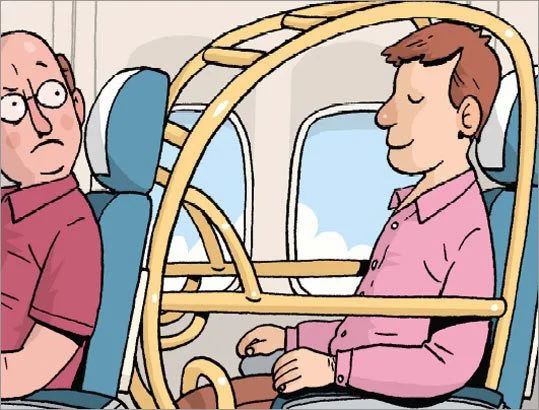
Chaos in Coach: Plane Nonsense and the Collapse of Jetiquette

August 29, 2014 Alex Packer
Illustration by Scott Garrett, Boston Globe

Illustration by Scott Garrett, Boston Globe

Did you hear about the recent United Airlines flight from Newark to Denver that was diverted for an unscheduled landing in Chicago after two passengers got into an altercation over a reclining seat? The fight started when The Man in Row 12 connected a gadget called the Knee Defender to his tray table to prevent the woman in front of him from reclining. She did not take kindly to this, so the flight attendant asked the man to remove the device. (United Airlines prohibits its use.) According to initial news reports, he refused. The man subsequently said that he did comply, but the woman then reclined her seat so violently that he reacted by pushing her seat back hard to reinstall his device. Upon which The Woman in Row 11 threw a cup of water at the man. Oh dear. I was on her side until then. So the flight made an unscheduled stop in Chicago and the miscreants were escorted off. The plane then continued to Denver, arriving nearly two hours late, in all likelihood causing a cascade of inconvenience and expense for many passengers. How rude!

I think we can all agree that flying can be stressful. Bouncing through bad weather has a way of making people think they’re going to miss their connection, hurl their lunch, or die. Throw in pervy pat-downs, sardine-like seating, screaming babies, smokers on edge, armrest hogs, jet lag, bad food, body odor, sweat pants, tank tops, and people with four carry-ons, and you’ve got ideal conditions for a manners meltdown.   

Nonetheless, misery is never an excuse for rudeness. So let’s dissect this airborne altercation to identify the manners violations. First, it was out of line for the man to install the Knee Defender (or Personal Space Protector or Laptop Lookout or whatever lofty name you want to give it to mask its hostile, entitled intent). He does not have the right to unilaterally restrict the comfort and range of motion another passenger expects and has paid for. Otherwise, what’s next? Placing duct tape over someone’s reading light because it’s in your eyes? Nailing down someone’s window shade to cut glare on your DVD player? Throwing out your neighbor’s lunch because you don’t like pepperoni pizza? 

So, Round One goes to The Woman in Row 11 whose seat was tampered with to prevent its reclining. It appears that her next step was to notify the flight attendant—so far so good—who asked The Man in Row 12 to remove the device. He says he did. At this point, The Women in Row 11 was clearly in the lead. But if she then reclined her seat as violently as the man reports, nearly breaking his laptop, and then he pushed back, and then she threw a cup of water at him, well, "who started it" tends to fade into the background. So the two of them ended up ejected from the game, er, plane.

To summarize…

         Restricting the movement of the seat back in front of you? Rude!

         Throwing a cup of water at the man who did it? Ruder!

         Causing delay and extra expense for innocent fellow passengers? Rudest!

Online aficionados know that it is at this point in the debate that the public weighs in with thoughtful, tolerant, solution-oriented comments. Here’s a sampling of a few of the milder ones:

         “I will grab your laptop and smack you in the head for being such a jerk.”

         “If I'm going to be uncomfortable because you want to recline, you're going to be
         uncomfortable because you get two knees jabbed into your back the whole time.”

         “Go ahead and stick your little plastic toy on my seat. You'll have a delightful trip as I
         bang into the back of my seat as hard as I can for as long as it takes. We'll find out what
         gives out first: your gadget, your laptop screen, your drink, or your sanity. “

In the midst of all this head-smacking, knee-gouging, drink-spilling vituperation, someone invariably makes an analogy to obese people who have to buy two seats if they are unable to fit into one; therefore, the reasoning goes, tall people should expect to purchase the seat in front of them or a first-class ticket if they wish to have room for their long legs. This inevitably leads to the assertion that tall people can’t help their height (and, therefore, should not have to pay extra for comfort), whereas fat people are simply making poor life choices and can voluntarily eat kale and become svelte whenever the spirit moves them (and, therefore, should be financially penalized for their self-destructive, other-inconveniencing indolence). And, faster than you can say “the seat belt sign is on,” these debates quickly devolve into nasty digital duke-outs of inflammatory comments about politics, gender, immigration, sexual orientation, Muslims, women, religion, Obama, and the Second Amendment.

Oh, people, can’t we calm down?

Let’s look for areas of agreement.

1)  The steady erosion of comfort on airplanes has led to increased tension and decreased legroom. Since this is not the fault of passengers, let’s unite over mutual condemnation of the airlines.

2)  The Geneva Convention never determined who owns the wedge of triangulated airspace described by the arc of a reclining seat back—the occupant of said seat, or the person whose knees are intruded upon. I would maintain, since the recline button is at the seat occupant’s fingertips, that he or she is in the command and control position. One could make the argument, however, that the airline is inviting seat battles by essentially selling the same space to two passengers—the one in front who expects to be able to recline her seat, and the one right behind her who expects to have space for his legs and laptop.

3)  A seat back, especially when violently reclined without warning, can cause pain, breakage, spillage, encumbrance, and inconvenience to the person or belongings in its path. At a minimum, seats should be reclined slowly and in stages.

Therefore, be it resolved that any progress in this arena can only be achieved in the following manner:

Airlines need to announce that devices restricting the movement of seats are not allowed.

Passengers need to increase their levels of empathy, consideration, and compromise. (Yes, you may say “Fat chance,” but really, doesn’t the maintenance of a civil society usually come down to those three concepts?) To help this along, here are some phrases passengers can use to minimize the likelihood of fisticuffs in the fuselage:

“Would you mind if I recline my seat?”

“I’d like go to sleep. I hope it won’t inconvenience you if I recline my seat.”

“Do you think you could wait to recline until I’ve finished my meal?”

“Would it be possible for you to recline just partway so I can use my laptop?”

“I have long legs and my knees are right up against your seat back. Could you please let me know if you’re going to recline so I can keep from being injured?”

Idealistic? Perhaps. But let’s look for the best in human nature, rather than the worst. Chances are your polite request or caution will be responded to in kind, resulting in a more moderate angle of recline, or none at all. And if problems persist, you can still ask the flight attendant to help you find a resolution or different seat.

In the meantime, I have a suggestion for the airlines in the spirit of current policies and economics:  Seat Comfort Auctions. We know the industry is heading towards Standing Room Only flights where passengers strap into vertical positions with tiny butt-rest shelves. Beverages, for a fee, will be available via drop-down tubes. Other tubes, also for a fee, will be available for restroom functions.

But until seats are eliminated, the airlines should stage pre-flight electronic auctions in which passengers compete for comfort with their neighbors by bidding to control armrests, window shades, seat backs, reading lamps, frequency of aisle access, contiguous passenger size, etc. Here’s how an online airline auction would work:

         “I have an opening bid of $10 from 33D to recline.”   

         “Do I hear $15 from 34D? Fifteen to decline recline?”  

         “Fifteen dollars. Recline blocked. Do I hear $20? Twenty to restore?”

         “Twenty dollars. Recline restored.”

         “Twenty-five to block. This is a steal. Full knee-cartilage comfort. Going… going… $25!
         Recline blocked by 34D for $25.”

         “Thirty dollars to you, 33D. Can you endure six hours of back pain? Only $30 for four 
         sweet inches of sway that’ll have you sleeping like a baby.”

         “33D? Do I hear $30? Going… going… sold to 34D for $25. Recline blocked. Knees
         saved.”

         “Our next lot will muzzle the compulsive talker in 34E. We’ll start the bidding at $50.”

Between mutual passenger courtesy and Seat Comfort Auctions, the battle over reclining seats should be resolvable. But please, God, don't let the airlines allow cell phone use in flight.

Comment

PDAs: Please Do Abstain (Part Two)

August 28, 2014 Alex Packer
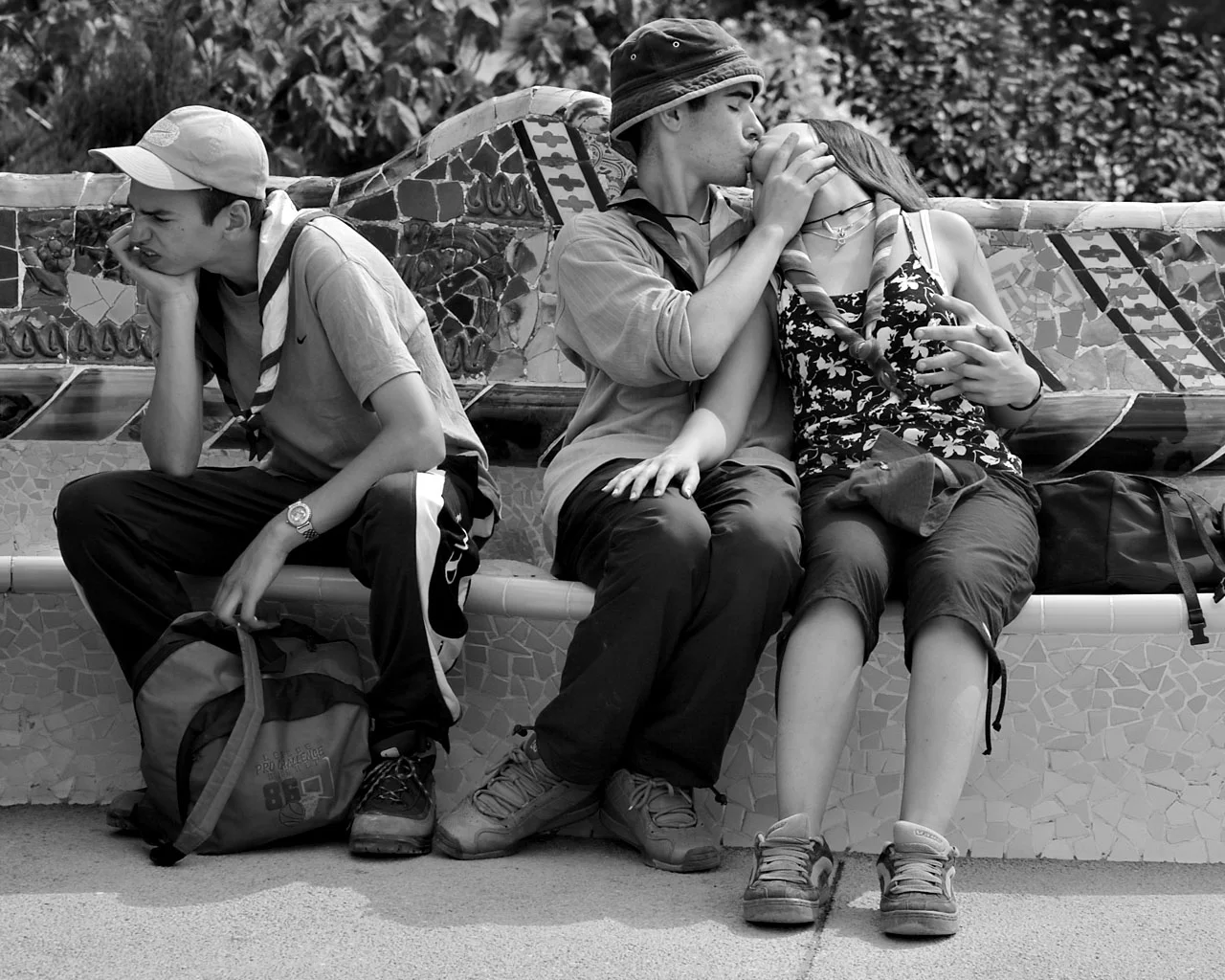
Photo by Scott Shephard

Photo by Scott Shephard

Here, in Part Two of my series on PDAs, are more questions and answers. May they lead us all to learn and follow the 3-Rs of publicly displaying affection: Respect, Restraint, Retreat.

Where should teens draw the line on PDAs?
Falling back upon the quaint baseball analogy, a PDA should never go beyond first base—hand-holding or a light and brief kiss, depending on how you define the bases. Recognizing that some of today’s teens go straight from the bullpen to winning the World Series without even rounding second, we may need to distinguish between different forms of PDAs. In the most innocent category are handshakes, hugs, air kisses, cheek busses, and quick lip smooches without tongue penetration. For the sake of thoroughness, one would also include couples kissing each other hello or good-bye, and the delightful physical affection that goes on between parents and young children that always brings a smile to observers, unless they are truly grumpy and heartless. The public display of anything beyond the aforementioned runs a high risk of being offensive to observers.

Finally, one must always consider age in determining the appropriateness of certain forms of contact. For example, when a grown-up bounces a child on his knees, it’s called a game. When a grown-up bounces another grown-up on his knees, it’s called a lap dance.

Do schools have rules about PDA?
Yes. Some schools prohibit PDAs. They believe that such displays are a distraction to the educational process, although I think many teens would argue that PDAs are highly educational. Since not all PDAs are equal, you find that some schools specify—kind of like a dress code—exactly what is and what isn’t permissible. One school might allow hand-holding but no kissing. Another school might permit walking down the hall with arms around the waist as long as fingers don’t stray into rear pockets. Basically, schools want to ban any activities that might lead to unscheduled trysts in the janitor’s closet or sub-par standardized test scores.

What is considered "rude" behavior in this area?
PDAs are rude when they…

…cross the line between endearment and lust

…compel a captive audience to watch or listen

…take place in settings not associated with such behavior.

Some settings are more affection-friendly than others. For example, it’s much more acceptable to make out in the Tunnel of Love than at the library. Eyebrows are less likely to be raised by a couple kissing in a paddle boat than at the Kroger fish counter.

If it bothers someone at school, what are some suggestions for teens on how to deal with it?

  • Don’t watch. With 360 degrees in which to focus one’s vision, look away.
  • Politely ask the couple to cease and desist. Own it as your sensitivity rather than their boorish behavior: “Hey, guys, it’s really hard for me to concentrate on my SAT with all the heavy breathing. Do you think you could wait until the test is over?”
  • Use peer pressure. In a voice just loud enough for the offending couple to hear without revealing your intent for them to do so, say: “Does anyone else besides me find it uncool to have to watch Biff and Buffy explore each other’s nether regions?”
  • Talk to a teacher, counselor, or other adult you trust in school. If PDAs are a school-wide problem that’s making a lot of kids uncomfortable, the administration may want to do something about it. This could include an assembly on the topic, a new PDA policy, asking the Student Council to look into it, or hosing kids down with water to keep their passions from igniting.
Comment

PDAs: Pretty Darn Annoying

August 27, 2014 Alex Packer

Many people ask me about Public Displays of Affection. First, let’s agree that the world can always use more affection. But, as the saying goes, there’s a time and a place for everything. And many practitioners of the PDA choose the wrong time and the wrong place for their amorous explorations. So that we can all traverse the public domain without feeling like extras in an R-rated movie, here’s a PDA Q&A for the romantically inclined. (Or disinclined.)

Why do people engage in PDAs? 
Because they’re horny. Or feeling affectionate. Or in love. They may want to show off to their friends, or make an ex-boyfriend or girlfriend jealous. 

Is there a sociological/psychological explanation for this? 
Yes. Human nature. Most people like to touch and be touched. In general, public displays of affection are lovely if they’re truly about affection: hand-holding, hugs, strolling arm in arm, loving contact between parents and children. Public displays of lust are not so lovely (except, perhaps, for those engaged therein). Most people are offended if they have to witness the steamy antics of others: fondling, groping, grabbing, licking, slurping, smooching. I, for one, do not wish to see a couple on the subway using their tongues to clean each other’s molars.

Is it different in the United States compared to other countries?
Yes. Etiquette and social behavior are highly contextual; a behavior that would be appropriate in one culture might horrify citizens of another culture. With regard to PDAs, zee French, of course, are very romantic, especially in Paris under a light drizzle. After all, it isn’t called French kissing for nothing. In certain other countries, public snogging leads to public flogging—or worse. In these places, kissing, holding hands, and/or wearing revealing clothing could get you in big trouble. It all depends on how each culture views these matters. In the U.S., where the concept of public modesty has yet to take hold, the display of affection for all to behold has become a widely-practiced spectator sport.

Are teens more apt to engage in PDAs than adults?
I’m not aware of any scientific studies that address this question. I do know that many young people, in general, seem less inhibited than adults when it comes to public behavior, i.e., being rowdy and rambunctious; sprawling across multiple seats on the bus; skateboarding over your toes. For some teens, having someone with whom you can be publicly affectionate is a bit like getting a new car. You want to give it a test drive and show it off to your friends.

Is there a kind of overall PDA-etiquette among teens? 
Yes. One must always have a partner for public displays of affection. Making out with yourself in a school corridor is considered bad form.

This concludes our examination of PDAs for today. In my next post I will respond to additional questions having to do with PDAs in the school setting.

Comment

On your mark… Get set… Uh… Er… Ummm…

August 26, 2014 Alex Packer
onyourmark.jpg

I used to teach creative writing to kids. Many times, upon receiving an assignment, students would come up to me, and say, “I’m stuck. I can’t think of the first sentence.”

“That’s all right,” I would say. “Just start with the second sentence.”

And what do you know? Rather than look at me as if I were crazy, they’d trot back to their desk and the words would flow. Somehow, permission to take a running start freed them from the terror of the blank page, from the paralyzing pressure to create the perfect first sentence.

And thus, I, obsessing over what my first post should be, will simply begin with the second.

Comment
← Newer Posts

About this blog

The focus is narrow: life, human behavior, culture, manners, education, child development, social research, kids, teens, schools, parenting, substance abuse prevention—
information that will be useful, museful, and entertaining, and provide you with things to think, yell, laugh, or get misty-eyed about.

Here you’ll find “How Rude Rants,” and “How Kind Kudos.” Survey results from teens, parents, and adults who work with kids. Reflections on bullies, buffoons, bigots, braggarts, and other obnoxious creatures.

I welcome your questions. And if you ask politely, I will even answer them. (Unless I get, like, 10,000.)

Recent Blog Posts


Featured
Cell phone uncle sam.jpg
Smart Phones and Stupid Mistakes: 12 Tips for Cell Phone Civility
Huge head phones.jpg
Hear Ye, Hear Ye: Noise Pollution and the Etiquette of Earbuds
Family Meeting 2 caricature.jpg
Close Encounters of the Worst Kind: Solving Family Problems
Helping parent with computer - cartoon.jpg
Living with Digitally-Challenged Parents: Coping Skills for Kids
Facebook Mom friend request 2.jpg
Minding Your Facebook Manners: A Guide for Parents
Tweets by @HowRudeBook